
The Comparison Trap
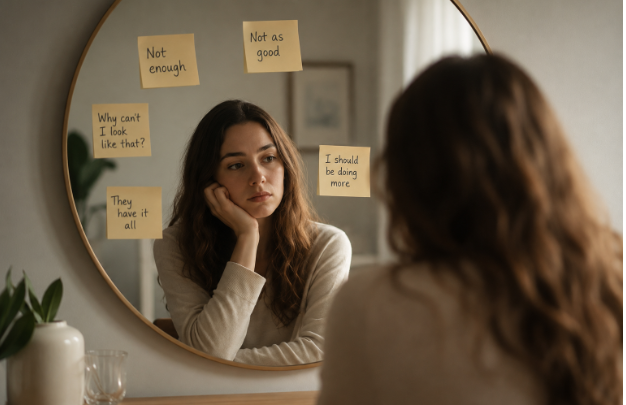
Most people know, at some level, that comparing themselves to others isn't helpful.
They know the image has been filtered, that someone else's body doesn't say anything about theirs, that what they're seeing on a screen isn't the full picture. And yet, knowing that doesn't stop the comparison. According to the National Library of Medicine, research has found that edited pictures of ordinary social media users have a greater influence than pictures edited by celebrities, most likely because adolescents and adults are more likely to compare themselves with peers than with models for both social and physical attributes. The comparison doesn't feel like a choice. It feels automatic, and it keeps happening even when the person doing it understands exactly why it's harmful.
Understanding what's actually driving the comparison, and what it does to self-image over time when it goes unaddressed, is different from just knowing that comparison is unhelpful. One is information. The other is the kind of insight that can actually interrupt the pattern.
If the way you see yourself feels tied to how you measure up against others, that's worth exploring with a clinician rather than just white-knuckling through it. Schedule an appointment with The Smith Counseling Group today.
Comparison Becomes a Default Way of Measuring Yourself
Social comparison isn't a personal failing. It's a deeply human cognitive process that happens quickly and often without conscious intention. Social media use fosters social comparison as users, consciously and subconsciously, compare themselves and their achievements to those of their peers, which can lead to feelings of inadequacy and low self-esteem, further contributing to distorted self-perception and increased body dissatisfaction. The issue isn't that comparison happens. It's what sustained, repeated comparison does to a person's baseline sense of themselves over time.
The Difference Between a Moment and a Pattern
A single comparison might produce a brief moment of self-consciousness and then pass. What tends to happen instead, especially in environments saturated with images and idealized content, is that comparison becomes a habitual lens. A person stops noticing they're doing it because it has become the default way they process information about themselves and others.
How This Changes Self-Image Over Time
Research shows increases in body dissatisfaction are linked to a range of mental health challenges, including anxiety, depression, and eating disorders. That link isn't accidental. When comparison becomes the primary way someone evaluates themselves, self-image stops being grounded in their own internal experience and becomes entirely dependent on a constantly shifting external reference point. The result is a self-image that never quite stabilizes, because it's always being measured against something else.
The Role of the Past in Present Comparison
Some of the comparison that feels like they're about the present, comparing a current self to a peer, a colleague, or someone on a screen, are actually a replay of something older. The way a person learned to evaluate themselves, the standards they internalized growing up, the comparisons that were made about or around them, shape what they notice and how they respond to it now.
What Treatment for Comparison-Driven Self-Image Distress Looks Like
Treatment typically doesn't involve trying to stop the comparison altogether. It involves understanding what drives it, what it's protecting against, and building a more stable internal sense of self that doesn't depend on how the comparison resolves. Approaches like Cognitive Behavioral Therapy, Internal Family Systems, and somatic work can each address different dimensions of this, depending on what's underneath the pattern for a particular person.

Frequently Asked Questions
Why do I keep comparing myself to others even when I know it makes me feel worse?
Comparison is largely automatic and doesn't respond well to the instruction to just stop. It's driven by deeper cognitive and emotional patterns, often including internalized standards about worth and acceptability, that don't shift just because a person understands intellectually that comparison isn't helpful.
Is social media making comparisons worse than they used to be?
Social media shapes standards of what is considered desirable and attractive, resulting in the creation of an unrealistic and difficult-to-attain image of the ideal body. Users are exposed to a distorted representation of reality that does not reflect the actual state of affairs, and the pursuit of this ideal can contribute to mental health issues.
Does comparison only affect how people feel about their bodies, or does it affect other areas, too?
Comparison affects self-image broadly, not just body image. It can shape how a person evaluates their relationships, achievements, lifestyle, and overall worth. Body comparison tends to be particularly salient because it's highly visible and heavily reinforced by the environments most people move through daily.
Why does comparing myself to someone from my past, like who I was in high school, feel different from comparing myself to someone else?
Comparisons with a past self carry a different emotional weight because they often involve grief, not just evaluation. They tend to raise questions about what changed, whether the change was a loss, and what it means for who someone is now. That kind of comparison is often worth exploring in therapy, specifically because it's rarely just about the past self.
Can comparison become part of an eating disorder or other clinical presentation?
Yes. Sustained body comparison is frequently part of the clinical picture in eating disorders and related conditions, where it often reinforces restriction, avoidance, or compensatory behaviors. If comparison is driving specific behaviors around food, movement, or appearance, that's worth bringing to a team that treats these patterns.
Is this something that gets better on its own, or does it tend to stay the same or worsen without support?
Without intervention, comparison-driven self-image distress tends to be self-reinforcing; the more a person compares, the more their self-image depends on external reference points, which requires more comparison to maintain. It doesn't typically resolve on its own.
What modalities does The Smith Counseling Group use to address comparison and self-image?
Our team draws from Cognitive Behavioral Therapy, Internal Family Systems, somatic and body-based approaches, and mindfulness, depending on what's driving the pattern for a specific person. The approach is tailored to the individual rather than applied as a one-size-fits-all protocol.
How do I know if what I'm experiencing is within the range of normal self-consciousness, or something worth bringing to a therapist?
A useful marker is whether the comparison is taking up significant mental space, driving specific behaviors, or affecting how you move through daily life. If it's influencing decisions about what you eat, where you go, what you wear, or how you engage with others, that's worth discussing with a clinician.
Can children and adolescents be affected by comparison-driven self-image distress?
Yes, and research suggests it often begins during adolescence, when peer comparison is developmentally prominent and the environments young people move through amplify it significantly.
How do I start if I'm not sure whether therapy is the right step for what I'm experiencing?
An initial conversation with a clinician can help clarify what's happening and what kind of support, if any, would be appropriate. There's no requirement to have it fully figured out before reaching out. Schedule an appointment with our team today.
The Goal Isn't to Notice. It's not to Not Be Defined by What You Notice.
Comparison won't disappear entirely, and the goal of treatment isn't to make it. The goal is to build a sense of self that's grounded enough that what you notice in others doesn't determine what you think about yourself. That kind of groundedness can actually be built with the right support.
Schedule an appointment today or talk with a team member about the comparison patterns that keep showing up for you, and what it would look like to build a sense of self that doesn't depend on how the comparison resolves.